


Error occured during this request! Please try again later.
Syria

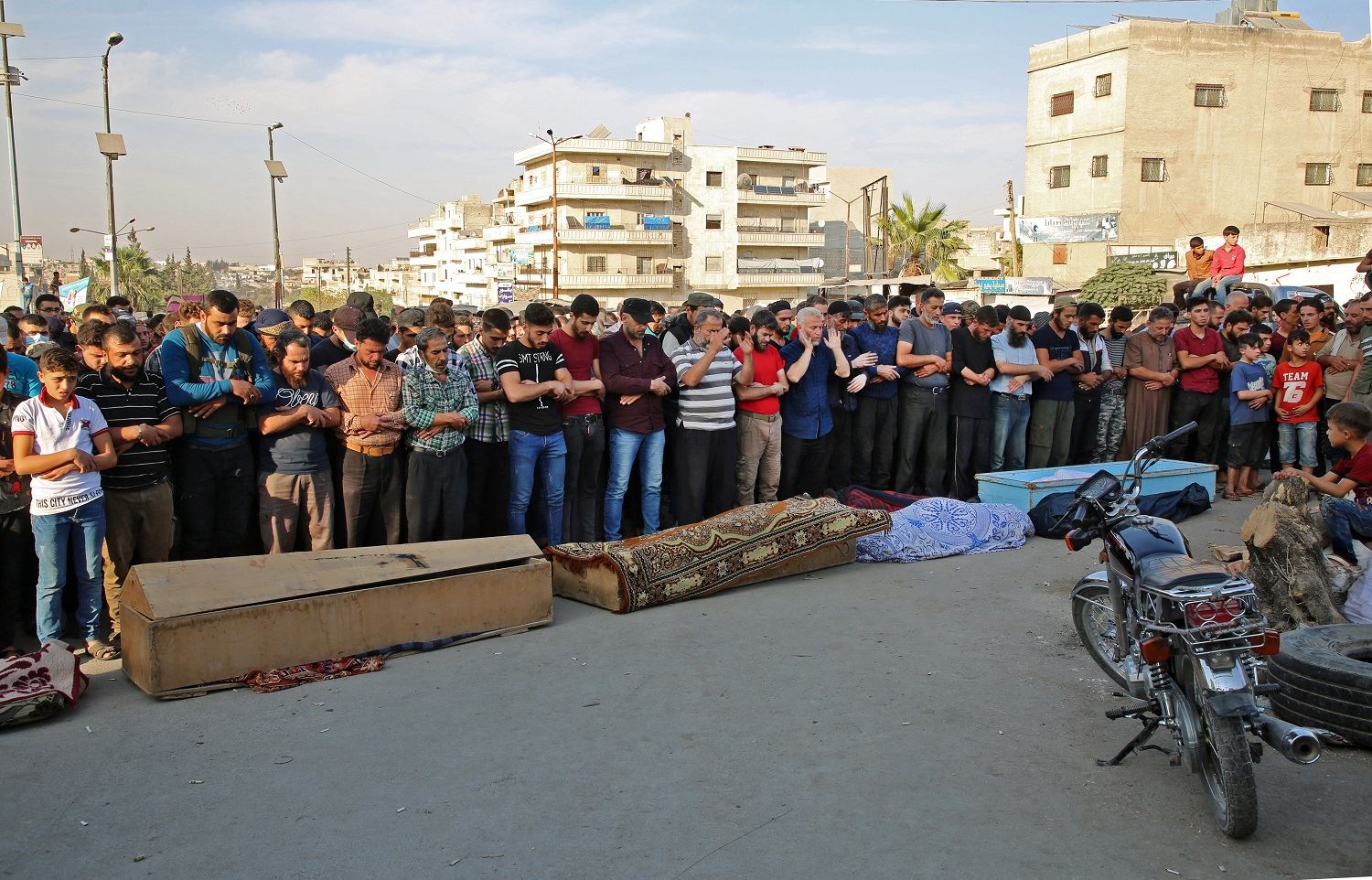
Syrians take part in the funeral of 10 fighters with the Turkey-backed Faylaq al-Sham rebel faction in Syria, in the northwestern city of Idlib, on October 26, 2020, following their death in a Russian air strike. Photo: Mohammed al-Rifai / AFP
ERBIL, Kurdistan Region — An airstrike killed at least 50 pro-Turkey rebel fighters in Syria’s northwestern province of Idlib and wounded tens of others on Monday, according to multiple sources. This is the deadliest attack on the jihadists this year.
Syrian Observatory for Human Rights (SOHR) said on Monday that the Russian military bombarded a training camp, belonging to the Faylaq al-Sham militia group, in the northwestern part of Idlib province, killing 78 members of the group. It added that “the death toll is expected to rise as more than 90 were injured, some in serious condition.”
However, a spokesperson for Syrian opposition told the Associated Press that more than 50 fighters were killed. He added that the targeted area is a training camp for Faylaq al-Sham - the largest Ankara-backed militia group. The spokesperson, Youssef Hammoud, blamed Russia for the airstrike.
Russia and Turkey brokered a ceasefire in the province in January and this has reduced clashes, but tension has escalated in recent days.
Today’s airstrike is the strongest and deadliest since the truce. Neither Russia nor Turkey have commented on the airstrike.
Idlib is one of the rebel’s last bastions in the country.
Syria’s conflict has killed at least 380,000 people and displaced millions of others to other parts of the country or abroad.
Charles Lister, the director of Middle East Institute’s Syria and Countering Terrorism and Extremism Program, believes Monday’s tensions could be de-escalated via a phone call between Turkish President Recep Tayyip Erdogan and Russian President Vladimir Putin.
“Today’s strike should be seen both within the microcosm of Idlib geopolitics, but also within the context of heightening Turkish-Russian tensions in Syria, Libya, and Azerbaijan,” he said in an analysis piece for the think tank.
Turkey has intervened in conflicts in Syria, Libya and Azerbaijan by supporting parties it sees as allies: it supports jihadists and rebels in Syria, supports the internationally recognized government in Libya and supports the Azerbaijan government in the fight against Armenia over Nagorno-Karabakh conflict.
“It is possible that despite the unprecedented scale of today’s incident, it will be de-escalated via a call between Russian President Vladimir Putin and his Turkish counterpart Recep Tayyip Erdogan.”
Syrian Observatory for Human Rights (SOHR) said on Monday that the Russian military bombarded a training camp, belonging to the Faylaq al-Sham militia group, in the northwestern part of Idlib province, killing 78 members of the group. It added that “the death toll is expected to rise as more than 90 were injured, some in serious condition.”
However, a spokesperson for Syrian opposition told the Associated Press that more than 50 fighters were killed. He added that the targeted area is a training camp for Faylaq al-Sham - the largest Ankara-backed militia group. The spokesperson, Youssef Hammoud, blamed Russia for the airstrike.
Russia and Turkey brokered a ceasefire in the province in January and this has reduced clashes, but tension has escalated in recent days.
Today’s airstrike is the strongest and deadliest since the truce. Neither Russia nor Turkey have commented on the airstrike.
Idlib is one of the rebel’s last bastions in the country.
Syria’s conflict has killed at least 380,000 people and displaced millions of others to other parts of the country or abroad.
Charles Lister, the director of Middle East Institute’s Syria and Countering Terrorism and Extremism Program, believes Monday’s tensions could be de-escalated via a phone call between Turkish President Recep Tayyip Erdogan and Russian President Vladimir Putin.
“Today’s strike should be seen both within the microcosm of Idlib geopolitics, but also within the context of heightening Turkish-Russian tensions in Syria, Libya, and Azerbaijan,” he said in an analysis piece for the think tank.
Turkey has intervened in conflicts in Syria, Libya and Azerbaijan by supporting parties it sees as allies: it supports jihadists and rebels in Syria, supports the internationally recognized government in Libya and supports the Azerbaijan government in the fight against Armenia over Nagorno-Karabakh conflict.
“It is possible that despite the unprecedented scale of today’s incident, it will be de-escalated via a call between Russian President Vladimir Putin and his Turkish counterpart Recep Tayyip Erdogan.”


Comments
Rudaw moderates all comments submitted on our website. We welcome comments which are relevant to the article and encourage further discussion about the issues that matter to you. We also welcome constructive criticism about Rudaw.
To be approved for publication, however, your comments must meet our community guidelines.
We will not tolerate the following: profanity, threats, personal attacks, vulgarity, abuse (such as sexism, racism, homophobia or xenophobia), or commercial or personal promotion.
Comments that do not meet our guidelines will be rejected. Comments are not edited – they are either approved or rejected.
Post a comment